



Dog Breeds
 Dog
Breeds Boards
Dog
Breeds Boards
Alaskan
Malamute
Bouvier des Flandres
Boxer
Dachshund
Dalmation
Doberman
German
Shepherd
Pug
Puppies!
Pup
Stages
Picking
from Litter
Bring Puppy Home
Bad
Puppy
Housetraining
Becoming
Alpha
Rescue
Dog
rescue
Adopt A Dog
Dog Rescue UK
Interview at a Pound
A Life in Chains
Adopt
a Dog Board
Saying
Goodbye
Letting
Go
Rainbow Bridge
Death
of Owner
Interesting links
Dog
Directory
Cats
Horses
Animal
rescue
Pet
Insurance
About us
Site Map
uno card rules
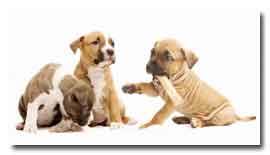
Preparing for a New Puppy.
Preparing for a New Puppy.
Okay, you've done your homework. You've read up and know exactly the type of dog to suit you and your family. You know the size and temperament and even whether a male of female pup would be a better companion for you. You've visited several breeders and chosen your new four legged friend from the litter and it is now time to take your healthy puppy home.
Checking your list
When parents find out they are going to have a child they make all sorts of preparations. A room is set aside and possibly the walls are covered with an appropriate wallpaper or paint, a supply of formula fills the pantry, baby bottles and diapers are purchased in huge quantities, toys and pacifiers are picked out, the baby's doctor is selected, etc. You need to make the same preparations for the puppy, and think about the equipment you'll need, the car ride home, and the puppy's activities, feeding, and health care check-up.
Equipment
Your puppy is going to need a room or at least a place it can call its own and a cage or crate will fill this bill. You are better off getting one that’s big enough for him to use as an adult. The pup will need food and water bowls, toys to chew on and play with, a collar and leash, a bag of a good quality dry puppy food, and plenty of newspapers or training pads. The bills are adding up!
The car ride home
The big day arrives and it’s off to pick up the puppy. Many people
worry that this is a traumatic event for the puppy but it probably isn’t
as bad as you might think. Coming home will start out with a car ride
from the shelter or breeder’s home. Try to keep this from being
a terrifying experience for the pup. The main problem dogs have with
car rides usually isn’t what we humans refer to as motion sickness
but simple anxiety about the vibrations, sounds and to a lesser degree
the movement. Many dogs that have developed problems with car rides get
nervous or even nauseous before the engine is even started. It’s
important that this first trip not be a bad experience that regresses
into a repetitious behavioral pattern.
Before you leave the kennel try to get your puppy to go to the bathroom so there are no floods or surprises stimulated by all the excitement or the ride.
On this first trip home we break a cardinal rule about travelling with pets. We do not put them in a crate for travelling. Remember they are small and easy to hold. Rather, we have someone other than the driver hold the puppy in a blanket or towel and talk or in some way try to distract it from the ride.
If you’ve got a long way to go and need to stop
for the puppy to relieve itself do not use a highway rest stop! At this
age the puppy has very little, if any, protection from common dog diseases
and these areas can easily be contaminated with the organisms causing
these conditions. We never recommend these facilities for pets of any
age but if you must use them, wait until your puppy has completed its
vaccination series.
Being with people the first day home
Leaving its mother and littermates will probably bring about some form of separation anxiety. However, this can be greatly diminished if you plan your schedules so you are with the puppy constantly for the first 3 to 4 days. Some authors suggest leaving the puppy alone and give it time to itself to adjust to the new surroundings. We disagree.
In our homes, we plan for this introductory period by keeping the puppy involved with plenty of attention from children and other family members through every one of its waking moments. When we aren’t with the puppy, she is eating, sleeping or going to the bathroom. You’ll be amazed how time spent in this manner will speed up the housebreaking process. If the children are young or are not familiar with how to handle puppies, you should spend some time with them during these first few days explaining common sense rules on how to play with the pup.
One thing to bear in mind is that most pups go through a 'mouthy' stage. This is perfectly normal and is simply an extension of the puppy learning about his environment. It doesn't mean you have chosen a vicious dog. It is especially important that you teach children how to deal with a mouthy pup in a positve manner and not a punitive one.
Getting a health check
One of the first things you need to do is get the puppy into a veterinarian for an initial puppy examination. You’ll want to make sure the pup is in perfect health, free of any congenital traits or other medical conditions. Also find out exactly what the breeder (or humane society) has done for the puppy. In all probability, the puppy has had some puppy vaccinations given by the breeder or shelter. It probably has also been placed on a deworming schedule and may even be on a heartworm preventative. It is common for all or some of these to have been done. This helps to explain some of the cost of your puppy regardless of where it was obtained. Your veterinarian will need all of this information along with an approximate birth date.
Feeding the puppy
What, when and how to feed puppies becomes a major issue on the first day. Many new owners worry that without its mother’s milk, their pup is going to have a hard time adjusting to its new home. Hopefully where you got the puppy will give instructions on what it has been eating. It is a good idea to continue feeding the same type and brand of food for at least a few days. Most people are soon surprised how well puppies make it through this transition because they don’t understand how far along dogs are in their development at 7 to 8 weeks of age.
Through our clinics and catalog business we work with hundreds of breeders and animal shelters. It’s common practice for most of these individuals to start feeding their puppies a commercial food at 21 days of age. Some of the toy breeds will start 3 to 4 days later. Even though their eyes didn’t open until 11 to 13 days old, just ten days later puppies are ready to start on something in addition to Mom’s milk.
Most breeders take dry puppy food, soak it in warm water for thirty minutes and then give it to the litter when they are 21 days old. The first day they may only stick their noses in it and try to lick some of the liquid. But after that, they eat and they eat very well.
After a week or so they are getting these feedings twice a day. This takes a huge burden off the mother especially when she has a large litter. Puppies fed on this sort of a schedule grow rapidly and with fewer problems.
As soon as possible, the amount of water mixed in the food is decreased and then finally eliminated. This depends on how fast the teeth are coming in and is done on the judgment and experience of the breeder. We always tell all new puppy owners to use a dry food formulated for puppies. Most 7 week old dogs can eat this as it comes from the bag without any problem. A few, especially members of the toy breeds, may need it moistened for one to two additional weeks but that is all.
© 2000 Drs. Foster and Smith, Inc.
Reprinted as a courtesy and with permission from
PetEducation.com
On-line store at http://www.DrsFosterSmith.com
Free pet supply catalog: 1-800-323-4208